


Are you launching an online store and hesitating between Shopify and PrestaShop? This choice will impact your daily operations for years. Each platform addresses different needs. PrestaShop offers complete control over your code and infrastructure. Shopify provides a turnkey solution with included hosting.
This comparison examines the truly important criteria: actual costs, ease of use, performance, customization, and scalability. You will discover which platform aligns with your technical expertise, budget, and business ambitions.
Pricing Comparison: PrestaShop vs. Shopify
PrestaShop: Free Software, But Not Without Costs
PrestaShop is an open-source CMS available for free. You download the software without paying a license fee. This initial freeness attracts many merchants.
However, you must anticipate certain costs. Web hosting optimized for PrestaShop costs between €3 and €20 per month, depending on your needs. Hosting providers like Hostinger or PlanetHoster often include a free domain name for the first year. The total annual cost ranges from €40 to €240 for basic expenses.
PrestaShop does not charge any commission on your sales. This absence of transaction fees is a major advantage as your volume increases. However, you will need to invest in paid modules for certain advanced features. Premium themes cost between €50 and €300. Essential modules add an additional €100 to €500, depending on your requirements.
Shopify: All-Inclusive Monthly Subscription
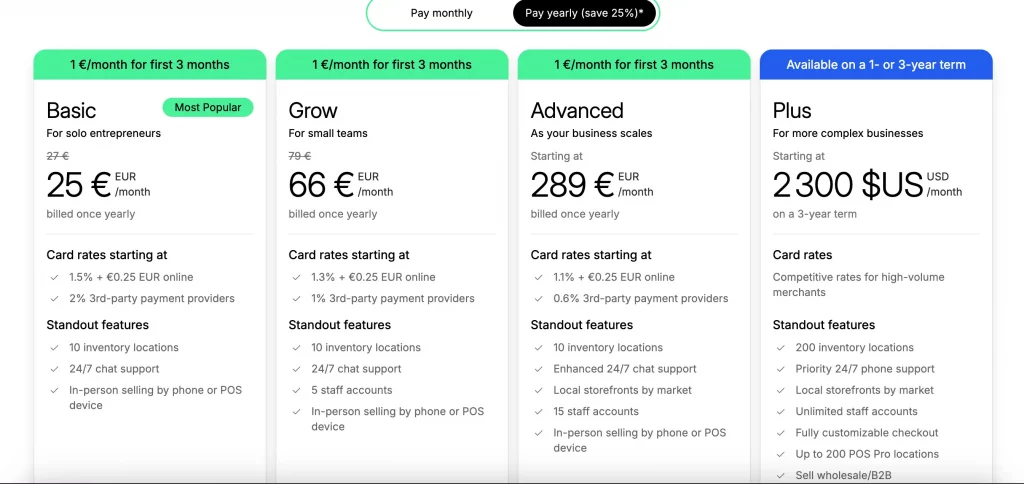
Shopify operates on a monthly subscription model. Three main plans are available: Basic at $29, Shopify at $79, and Advanced at $299 per month. Shopify Plus is designed for large enterprises with custom pricing starting at $2,000 monthly.
The subscription includes secure hosting, an SSL certificate, automatic updates, and customer support. You do not have to manage these technical aspects. Shopify offers a 14-day free trial to test the platform.
Transaction fees vary depending on your plan. Without Shopify Payments, you pay between 0.5% and 2% commission on each sale. These fees are waived if you use Shopify’s integrated payment system. Some third-party applications require additional subscriptions, typically between $5 and $30 per month.
Cost Verdict
PrestaShop initially appears less expensive. In the long run, costs accumulate with hosting, paid modules, maintenance, and developers. A PrestaShop site can ultimately cost 2 to 3 times more than a Shopify subscription over several years.
Shopify offers predictable pricing. You know your monthly expenses from the outset. This transparency facilitates budget management, especially for small businesses and entrepreneurs.
Ease of Use and Getting Started
PrestaShop: Technical Learning Curve
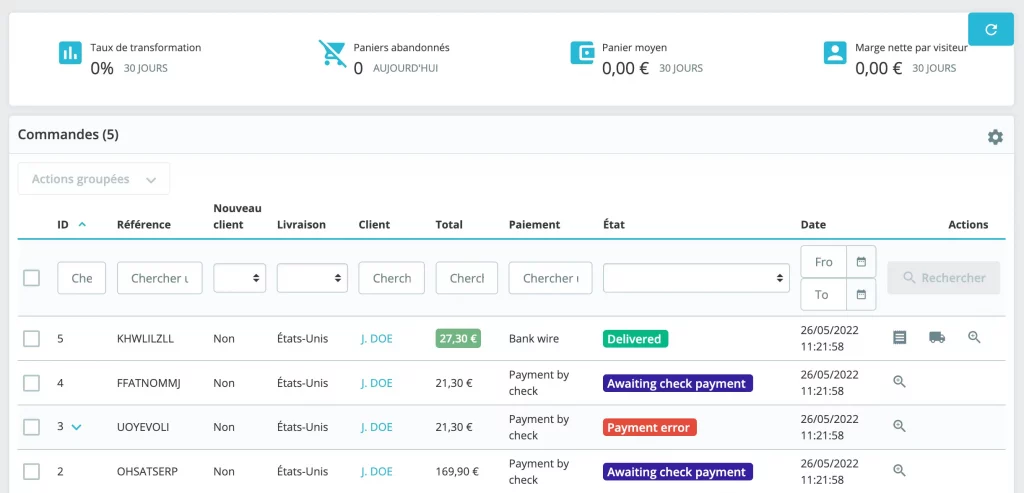
PrestaShop requires technical skills for installation and configuration. You must first subscribe to web hosting, then install the CMS on your server. Some hosting providers offer automated installations, but the process remains less intuitive than Shopify.
Customizing your store requires time and patience. The back-office interface contains numerous features spread across different menus. This functional richness can be daunting for beginners. You will need to test, adjust, and sometimes restart to achieve the desired result.
PrestaShop is suitable for individuals with a technical background or those with a development team. The platform offers complete control over every aspect of your store. This flexibility comes at a price: it demands time and knowledge.
Shopify: Simplicity for All Skill Levels
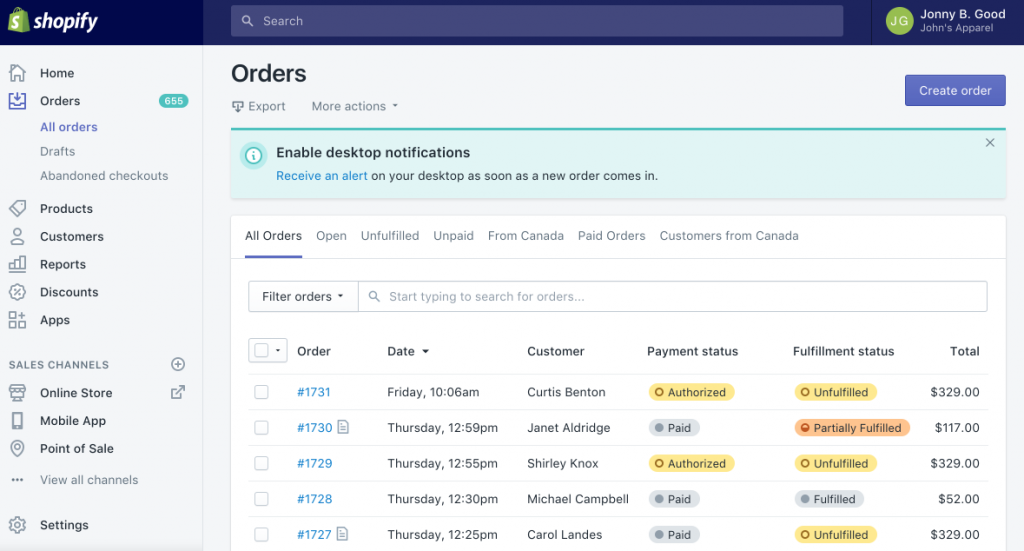
Shopify stands out for its ease of use. You can create your store without web development knowledge. Registration grants you access to a ready-to-use store. Hosting and security are managed automatically.
The editor operates with drag-and-drop functionality. You customize your site with a few clicks. Themes automatically adapt to mobile devices. Adding products, managing inventory, and processing orders are done intuitively.
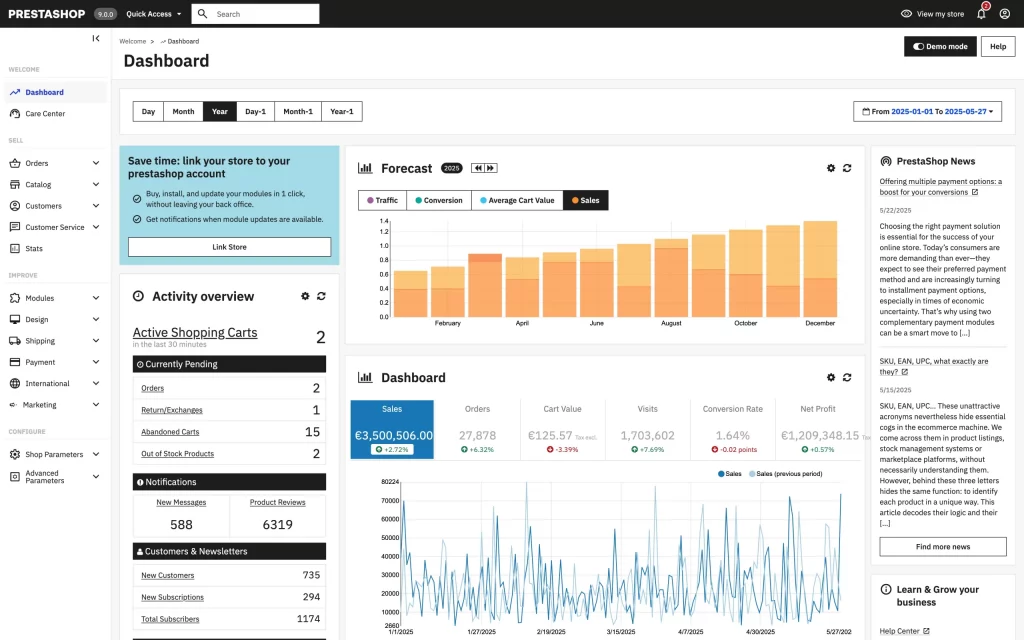
The dashboard centralizes all your important data. You can view your sales, track your performance, and manage your customers from a single interface. This user-friendly approach allows you to focus on what matters most: selling and growing your business.
Which System to Choose Based on Your Profile
Shopify is ideal for beginners and busy entrepreneurs. You can launch your store in a few hours without technical complications. PrestaShop is suitable for experienced users seeking maximum control over their platform.
Customization and Design
Available Themes and Templates
PrestaShop offers over 2,300 free and paid themes on its Addons marketplace. This library provides a varied selection for different business sectors. Premium themes generally cost between €70 and €300. Quality varies considerably from one theme to another.
Shopify provides approximately 200 themes, 9 of which are free. All Shopify themes are designed specifically for e-commerce. They adhere to performance and accessibility standards. Paid themes cost between $140 and $350. Each theme includes several predefined styles that you can customize.

Customization Options
PrestaShop allows unlimited customization of the source code. You can modify every aspect of your store if you are proficient in HTML, CSS, PHP, and JavaScript. This complete freedom appeals to developers and web agencies. You can create custom features tailored to very specific needs.
Shopify limits code access in certain areas to maintain platform stability. You customize your theme via the visual editor or by modifying Liquid code. Experienced developers create fully customized stores. Limitations primarily arise for very specific needs requiring deep structural modifications.
Extensions and Add-on Modules
PrestaShop has over 3,000 modules on its marketplace. These modules add features such as SEO optimization, advanced inventory management, or marketplace integration. Many essential modules are paid. Prices range from €50 to several hundred euros. The quality of modules is not always guaranteed.
Shopify has over 6,000 applications in its App Store. Many free applications cover basic needs. Paid applications generally offer more affordable monthly rates than PrestaShop modules. The Shopify ecosystem remains more controlled, with higher quality and security standards.
Native Features and Integrated Tools
Product and Inventory Management
Both platforms efficiently manage product catalogs. You can create comprehensive product pages with descriptions, images, variants, and options. PrestaShop offers native multi-store management, allowing you to manage multiple sites from a single installation. Shopify does not offer this feature as standard.
Inventory management is performed directly from the back office on both platforms. Shopify automatically synchronizes your inventory across your different sales channels. PrestaShop often requires additional modules for this synchronization.
Accepted Payment Methods
PrestaShop and Shopify support all standard payment methods. You can offer payment by credit card (Visa, Mastercard), PayPal, Stripe, and other solutions. PrestaShop integrates with various providers via modules, some of which are free, like PayPlug.
Shopify offers its own payment system: Shopify Payments. This system eliminates the additional transaction fees that Shopify normally charges on third-party payments. You also get access to Apple Pay, Google Pay, and Shop Pay to enhance the customer experience.
Sales Channels and Marketplaces
Shopify excels in multichannel selling. You can connect your store for free to Facebook, Instagram, Amazon, eBay, and other platforms. These native integrations simplify managing your sales across multiple channels from a single interface.
PrestaShop also integrates marketplaces, but via paid modules. This approach generates additional costs. Synchronization between your store and marketplaces requires more configuration than with Shopify.
Physical POS
Shopify offers Shopify POS to manage your in-store sales. This system synchronizes your inventory and customer data between your online store and your physical points of sale. The mobile application transforms your tablet or smartphone into a cash register.
PrestaShop requires the installation of third-party modules to obtain similar functionalities. These solutions vary in quality and reliability. The cost and integration complexity generally exceed what Shopify offers.
SEO and Organic Search
PrestaShop offers a solid foundation for SEO. The platform generates clean URLs and allows for complete customization of title tags, meta descriptions, and data structure. You control every technical aspect of your SEO. Modules like SEO Expert add advanced functionalities.
Shopify regularly improves its native SEO capabilities. The platform automatically generates XML sitemaps, manages 301 redirects, and optimizes loading speed. The main limitations concern URL structure (it’s impossible to remove /collections/ or /products/) and a less flexible breadcrumb navigation than on PrestaShop.
Both platforms allow for good organic search results. PrestaShop offers more technical control for advanced optimizations. Shopify focuses on simplicity with solid performance without complex configuration.
Performance and Loading Speed
Loading Speed
Shopify hosts all stores on its optimized infrastructure. Servers are configured specifically for the platform. Pages load quickly without your intervention. Shopify automatically manages caching, image compression, and code optimization.
PrestaShop is entirely dependent on your hosting provider. Poor quality hosting significantly slows down your store. You must choose a high-performance host and correctly configure your server. This responsibility rests entirely with you. Good PrestaShop hosting can rival Shopify in terms of performance.
Traffic Handling Capacity
Shopify seamlessly handles significant traffic spikes. The infrastructure automatically adapts to your needs. Thousands of stores use Shopify for product launches and flash sales without service interruption.
PrestaShop requires scalable hosting to manage traffic surges. You must anticipate your needs and upgrade to a higher plan before periods of high traffic. This manual management demands vigilance and technical skills.
Security and Reliability
Shopify includes a free SSL certificate, automatic updates, and 24/7 monitoring. The platform is PCI-DSS Level 1 certified, the highest security standard for online payments. You do not need to take any action to maintain this level of security.
PrestaShop requires you to manage security yourself. You must install and renew your SSL certificate, apply security updates, and monitor your site for threats. This responsibility demands constant vigilance or professional assistance.
Customer Support and Help Resources
Shopify Support
Shopify offers 24/7 customer support via chat, email, and phone. This service is available to all subscribers, regardless of their plan. Teams respond in multiple languages, including French. Response times are generally short.
Shopify documentation covers all aspects of the platform. Free video tutorials, webinars, and online courses support merchants. The community forum has thousands of active members who share their experiences and solutions.
PrestaShop Resources
PrestaShop has an active community and detailed documentation in French. Forums, tutorials, and guides are available for free. Phone support exists, but personalized support requires a paid subscription.
PrestaShop support plans start at €249 and go up to €1,399 depending on the level of assistance. These packages include technical help, audits, and personalized follow-up. Without these packages, you rely on the community or independent developers.
The difference is notable: Shopify includes support in all its subscriptions, while PrestaShop charges for it separately.
Dropshipping and Suppliers
PrestaShop supports dropshipping via numerous modules. You can connect your store to AliExpress, BigBuy, BDroppy, and other suppliers. The major advantage: PrestaShop does not charge any additional commission on your dropshipping sales. Your margins remain intact.
Shopify facilitates dropshipping with applications like DSers (formerly Oberlo) and Spocket. Integration is simple and fast. Applications automatically synchronize products and orders. You pay subscription fees for certain applications in addition to your Shopify plan.
Both platforms are suitable for dropshipping. Shopify offers faster setup. PrestaShop allows for long-term savings on commissions.
Scalability and Growth Capacity
Managing Growth on PrestaShop
Your PrestaShop store grows with your business, but you must manage this evolution. An increase in traffic requires an upgrade to your hosting. You must monitor performance and anticipate your needs. Hosting providers generally offer simple migrations to higher-tier plans.
PrestaShop technically handles large volumes of products and orders. Some PrestaShop stores have tens of thousands of references. The limit primarily depends on your hosting and your technical optimizations.
Growth on Shopify
Shopify automatically adapts to your growth. The infrastructure manages traffic surges without intervention. You simply upgrade to a higher plan when you need advanced features. Shopify Plus is designed for businesses exceeding several million euros in revenue.
Brands like Gymshark (500 million in annual revenue), Heinz, Allbirds, and Kylie Cosmetics use Shopify. These examples prove that the platform handles significant volumes. You will not hit a technical ceiling that would force a migration.
Blog and Content Marketing
Shopify integrates a native blog system into all stores. You publish content directly from your administration panel. The blog shares the same design as your store. This consistency strengthens your brand image. Articles are easily optimized for SEO with standard tags.
PrestaShop requires the installation of a module to add a blog to your store. Several modules exist, both free and paid. This additional step complicates implementation. The quality and features vary depending on the chosen module.
Multi-Store Management
PrestaShop excels in multi-store management. A single installation manages multiple sites with different or shared catalogs. You administer several brands from a unique interface. This native functionality represents a major advantage for businesses managing multiple brands.
Shopify does not offer native multi-store functionality. You must create and manage each store separately, with distinct subscriptions. Third-party applications allow for synchronizing certain data between stores, but without achieving PrestaShop’s flexibility.
Access and Team Management
PrestaShop allows an unlimited number of users in the back office. You can create as many accounts as needed for your team. Each user receives specific permissions according to their role. This granular rights management is suitable for large teams.
Shopify limits the number of accounts based on your plan. The Basic plan includes 2 accounts, Shopify offers 5, and Advanced provides 15. Shopify Plus removes these limitations. For small teams, these quotas are generally sufficient.
Platform Migration
Migrating from PrestaShop to Shopify
Migrating from PrestaShop to Shopify is performed using dedicated tools like Store Importer or specialized applications. These tools transfer your products, customers, orders, and categories. The process takes a few hours for a standard store. However, for a larger store, it is important to consult a specialist.
Certain elements require special attention. URLs change structure, so you must implement 301 redirects to preserve your SEO. PrestaShop modules do not always have a direct equivalent on Shopify. A specialized agency secures the migration and preserves your assets.
Migrating from Shopify to PrestaShop
This migration is less common but possible. You must back up all your Shopify data and then import it into PrestaShop via scripts or modules. The process is more technical than the reverse. URLs and the structure change completely.
The reasons motivating this migration generally include the need for advanced customization, reduced monthly costs, or the elimination of sales commissions. An expert PrestaShop agency manages this complex transition.
Shopify vs PrestaShop Comparison Table
| Criteria | PrestaShop | Shopify | Winner |
|---|---|---|---|
| Initial Cost | Free (software) | $29 to $299/month | PrestaShop |
| Hosting | Your responsibility (€3-20/month) | Included and unlimited | Shopify |
| Sales Commissions | 0% | 0.5% to 2% without Shopify Payments | PrestaShop |
| Ease of Use | Training Required | Intuitive for beginners | Shopify |
| Customization | Total (open source) | Sufficient | — |
| Available Themes | 2 300+ | 200+ | PrestaShop |
| Apps/Modules | 3 000+ | 6 000+ | Shopify |
| Native SEO | Excellent technical control | Good level | PrestaShop |
| Customer support | Paid (€249-1,399) | Included 24/7 | Shopify |
| Multi-store | Native | Not available | PrestaShop |
| Security | To be managed independently | Managed automatically | Shopify |
| Scalability | Depends on hosting | Automatic | Shopify |
| Integrated blog | Via module | Native | Shopify |
| Physical POS | Third-party modules | Native Shopify POS | Shopify |
| Team accounts | Unlimited | 2 to 15 depending on plan | PrestaShop |
Advantages and disadvantages of each platform
Strengths of PrestaShop
PrestaShop offers total control over your store. You access the source code and modify every aspect according to your needs. This flexibility appeals to developers and businesses with specific requirements. No commissions reduce your margins, regardless of your sales volume.
Native multi-store management allows you to manage several brands from a single installation. Monthly costs remain predictable, with only hosting to pay for. The active French-speaking community facilitates problem-solving.
Limitations of PrestaShop
Getting started requires time and technical skills. You manage hosting, security, updates, and maintenance yourself. This responsibility can become a burden for merchants who wish to focus on their business.
Paid modules quickly add up to gain advanced features. The variable quality of these modules sometimes causes compatibility issues. Official customer support requires a paid subscription, unlike competitors.
Strengths of Shopify
Shopify simplifies the creation and management of an online store. You can launch your business in a few hours without technical knowledge. Hosting, security, updates, and backups are managed automatically. This peace of mind has considerable value.
24/7 customer support answers your questions in French. The app ecosystem offers solutions for almost all needs. Native integrations with social networks and marketplaces simplify multichannel sales.
Limitations of Shopify
The monthly subscription represents a fixed cost, even without sales. Transaction fees are added if you do not use Shopify Payments. Advanced customization quickly reaches its limits for very specific needs.
You depend on Shopify for hosting and infrastructure. You are subject to price increases or policy changes. Multi-store management requires separate subscriptions for each site.
How to choose between Shopify and PrestaShop
Choose Shopify if you are in these situations
You are new to e-commerce and looking for a simple solution. You want to focus on your products and customers rather than on technical aspects. Your budget allows for a fixed monthly subscription. You appreciate having support available at all times.
You sell across multiple channels (online store, social networks, marketplaces). You anticipate rapid growth and want an infrastructure that adapts automatically. Your business requires a physical point of sale synchronized with your online store.
The fashion, beauty, and luxury sectors find Shopify a suitable solution for their needs. Premium brands appreciate the elegant themes and refined user experience. The ease of management allows for quick launching of collections and campaigns.
Choose PrestaShop if you are in these situations
You have in-house technical skills or work with a web agency. You require highly advanced customization that SaaS platforms cannot offer. Your budget prioritizes low fixed costs without sales commissions.
You manage multiple stores and want to administer them from a single interface. You sell a large volume, and every commission point matters. Your project requires custom developments specific to your industry.
PrestaShop is suitable for established businesses looking to maintain total control over their infrastructure. Very large catalogs with complex management rules benefit from PrestaShop’s flexibility.
Frequently asked questions
Which platform is cheaper between Shopify and PrestaShop?
PrestaShop appears cheaper initially because the software is free. You only pay for hosting, the domain, and necessary modules. Shopify charges a fixed monthly subscription including hosting and support. Over several years, PrestaShop can be more expensive with the accumulation of module, maintenance, and development costs.
Is dropshipping possible with both platforms?
Yes, both PrestaShop and Shopify support dropshipping. Shopify offers apps like DSers that simplify product import and order management. PrestaShop integrates with AliExpress and other suppliers via modules. PrestaShop does not add additional fees to your dropshipping sales, unlike some Shopify plans.
Which Platform is Better for SEO?
PrestaShop offers better technical control over all SEO aspects. You can customize URLs, structure, tags, and structured data without limitation. Shopify imposes certain constraints, such as the /collections/ and /products/ structure in URLs. Both platforms allow for good SEO, but PrestaShop is better suited for advanced SEO strategies.
Is it easy to migrate from one platform to another?
Migrating from PrestaShop to Shopify uses tools like Store Importer that transfer products, customers, and orders. The operation takes a few hours for a standard store. You must manage 301 redirects to preserve your SEO. The reverse migration (Shopify to PrestaShop) is more technical and often requires the assistance of an agency.
What technical level is required to use each platform?
Shopify requires no technical skills. You create your store by following a guided process. PrestaShop requires knowledge of server administration, database management, and sometimes web development. Without a technical team, PrestaShop requires engaging external service providers.
Which platform better handles large sales volumes?
Shopify automatically handles scaling thanks to its scalable cloud infrastructure. Brands generating millions of euros use Shopify without issues. PrestaShop also supports large volumes, but you must correctly size your hosting. Performance depends entirely on your infrastructure choices.
Conclusion: Shopify or PrestaShop in 2026?
Shopify and PrestaShop address different needs. Shopify excels in its simplicity and all-in-one management. You can quickly launch your store without worrying about technical aspects. Hosting, security, and updates are managed automatically. 24/7 support and the app ecosystem facilitate growth. This solution is suitable for entrepreneurs, small businesses, and brands seeking efficiency.
PrestaShop offers total freedom over your infrastructure. You control every aspect of your store and pay no commissions. This platform is aimed at businesses with technical resources or working with agencies. The lower initial cost is appealing, but expenses accumulate with modules, hosting, and maintenance.
The choice depends on your situation. Evaluate your technical skills, your total budget over 2-3 years, and the time you can dedicate to technical management. Shopify is suitable for 80% of e-commerce projects. PrestaShop remains relevant for very specific needs requiring advanced customization.
For fashion, beauty, and luxury brands, Shopify offers a tailored solution combining refined design and commercial performance. KNR supports premium brands in their migration to Shopify and the creation of high-performing stores aligned with their ambitions.


